
Harness Engineering: Design Patterns for Securing Long-Horizon Multi-Agent AI Systems
The professional edition of Harness Engineering is now available on Kindle.

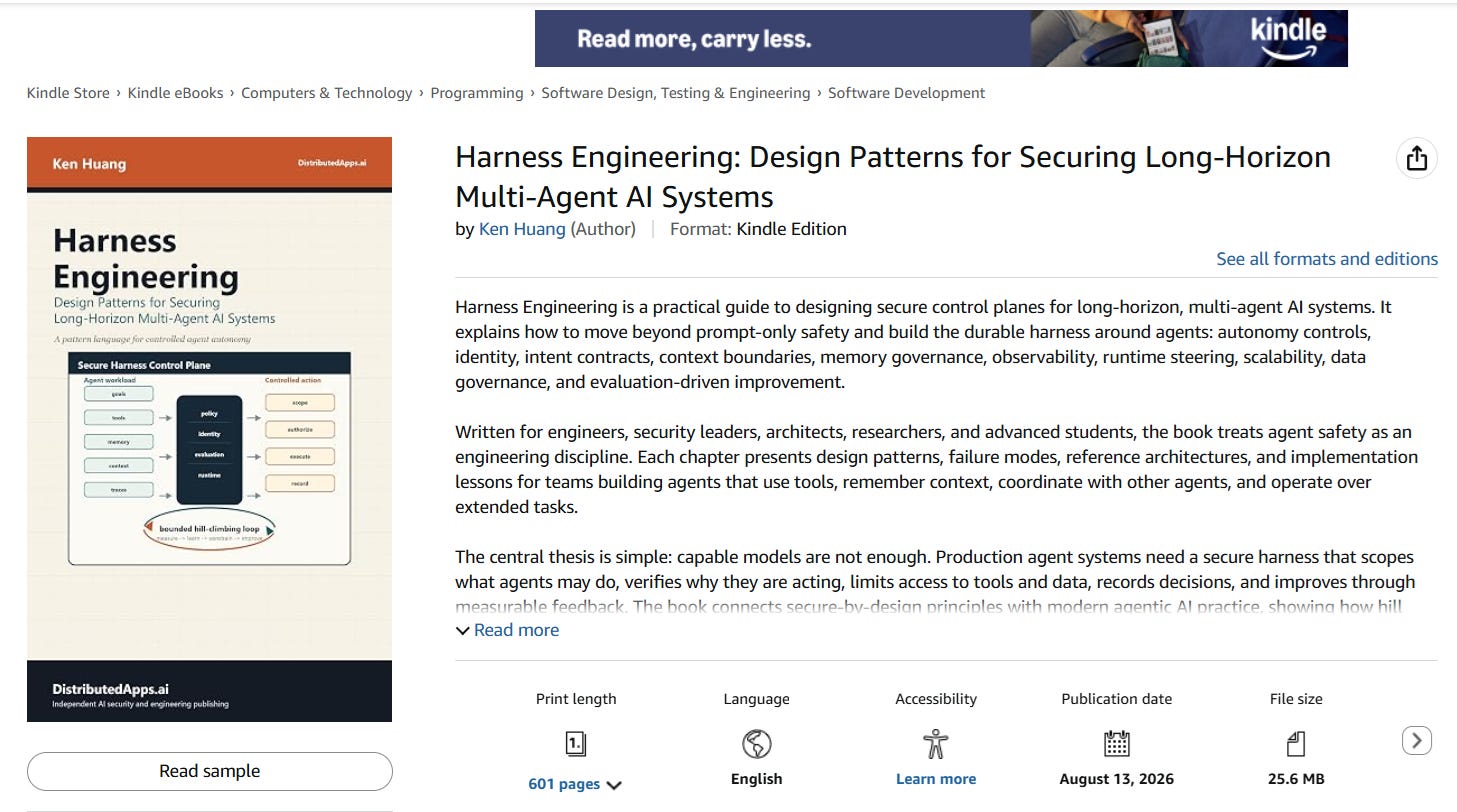
I am pleased to announce the professional edition of my new book, Harness Engineering: Design Patterns for Securing Long-Horizon Multi-Agent AI Systems.
The Kindle edition is available here:
Harness Engineering on Amazon Kindle
This book is about a shift I believe is now becoming unavoidable. We are transitioning from Software Engineering for deterministic IT systems to Harness Engineering for non-deterministic Agentic AI systems.
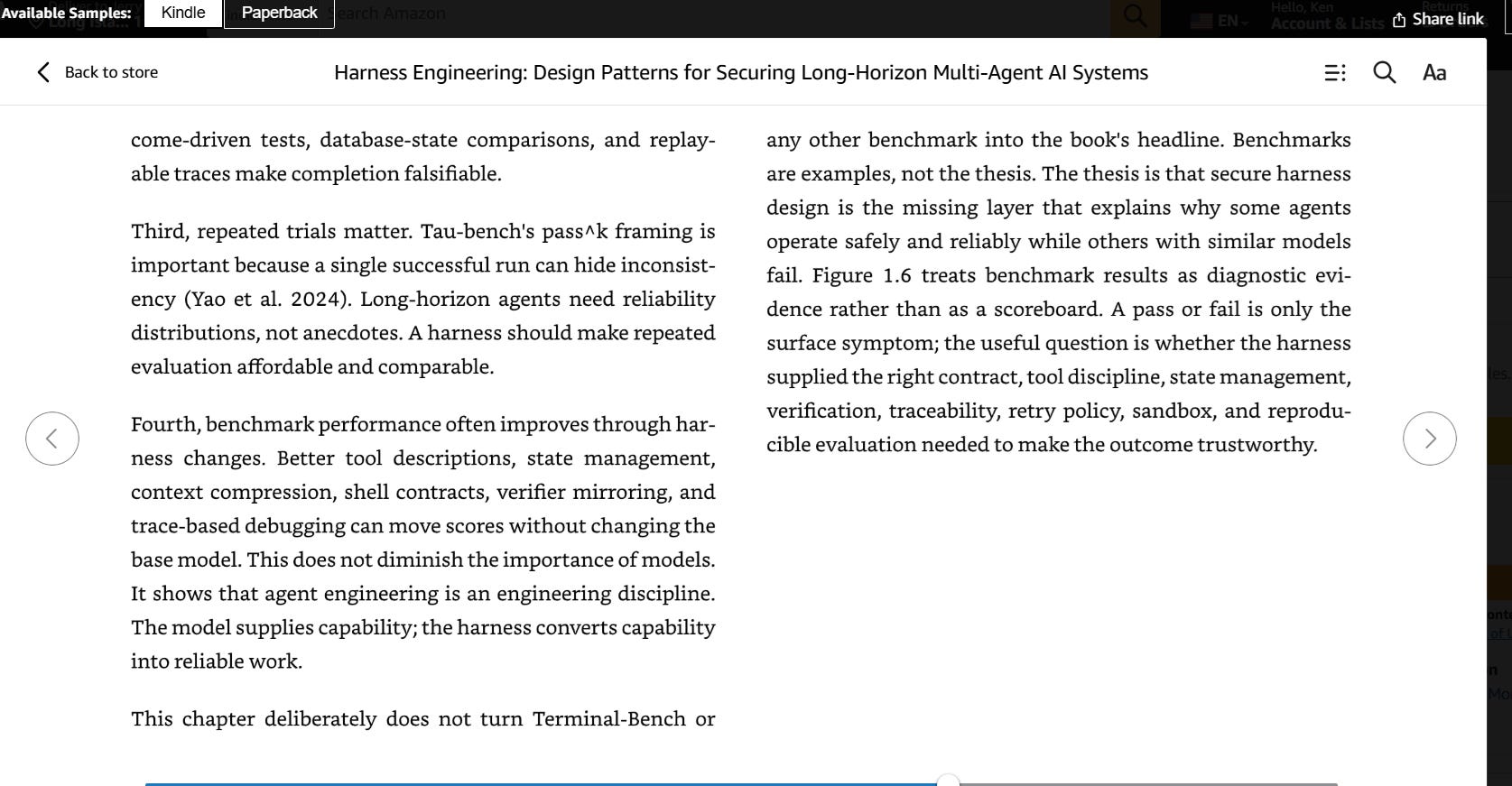
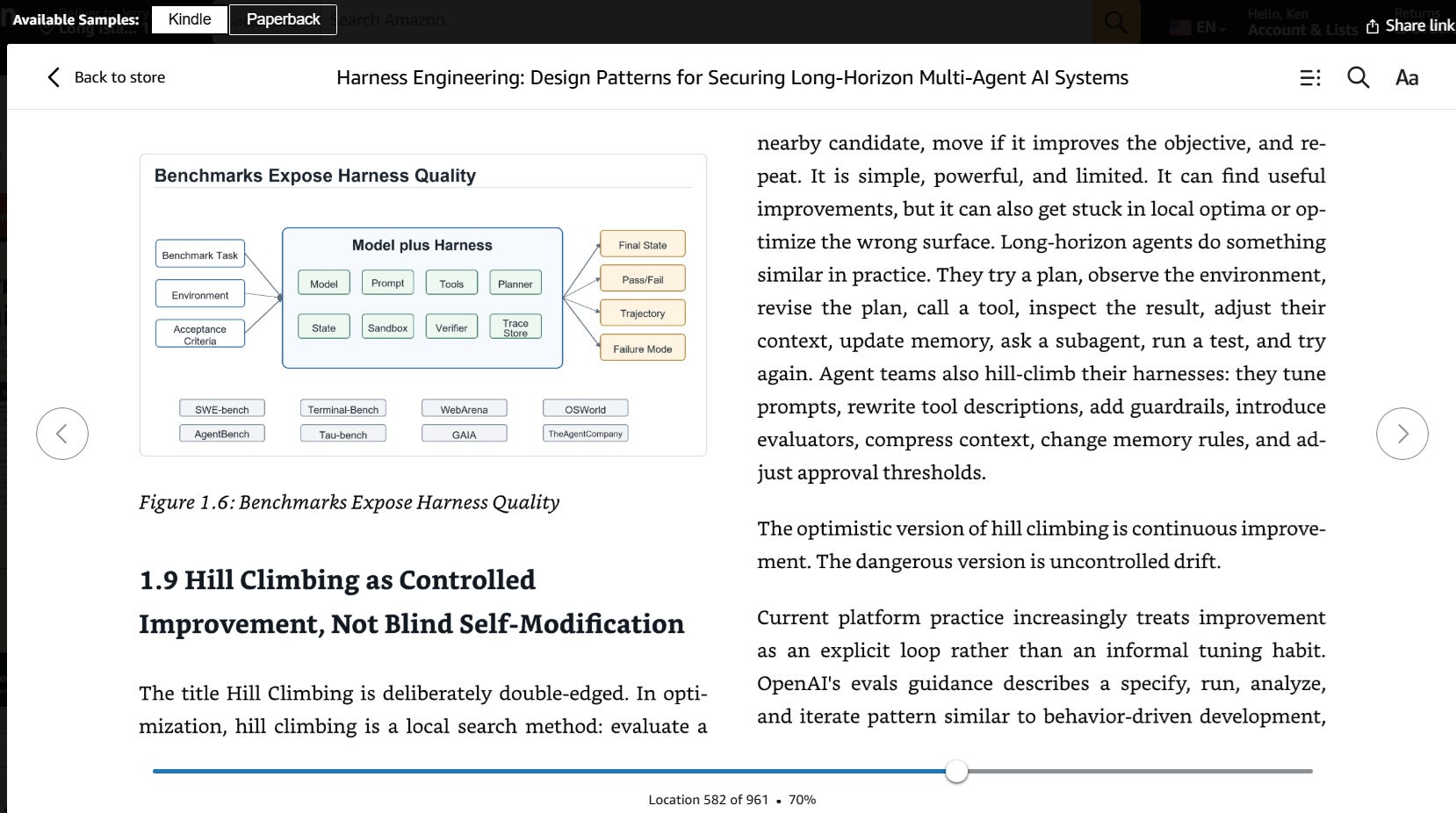
I wrote about this shift recently in Harness Engineering as the Umbrella Discipline. That article argues that prompt engineering, context engineering, memory engineering, loop engineering, graph engineering, tool engineering, and evaluation engineering are not separate islands. They are parts of a larger discipline. The professional book develops that argument into a complete design-pattern language for production agentic AI systems. The following are some screenshots for the Kindle version of this book; the first chapter is free on Kindle.
The Need for this Book
The first wave of generative AI work treated the model as the product. The second wave treated the application wrapper as the product. The third wave, which is already here, treats the harness as the product boundary. A useful agent is not just a clever model with a prompt. It is a system that can plan, call tools, interact with data, recover from mistakes, operate over time, and remain accountable when many subagents or services are involved.
That matters because long-horizon agents fail differently from short chat sessions. They accumulate context. They carry memory across tasks. They delegate work. They retry. They adapt. They can become overconfident after partial success. They can also create new attack surfaces through tool access, identity delegation, prompt injection, memory poisoning, unsafe autonomy, and weak observability. The OpenAI/Huggingface incident is one such example.
Harness Engineering is written for the people who have to build and govern these systems in practice: AI engineers, security architects, platform teams, product leaders, researchers, graduate students, and technical executives who need a clear framework for safe agent deployment.
What the book covers
The book organizes secure agentic AI around ten pattern families:
Autonomy, where the harness defines what an agent may decide by itself and what must be escalated.
Identity, where agents, tasks, tools, and delegated actions receive scoped, auditable identity.
Intent, where goals become contracts that can be checked before actions are authorized.
Context, where trusted and untrusted information are separated before they shape agent behavior.
Memory, where long-term recall becomes a governed, validated, and reversible store.
Observability, where traces, logs, decisions, and evaluations make agent behavior inspectable.
Runtime steering, where a running agent can be interrupted, redirected, paused, or stopped safely.
Scalability, where coordination controls prevent multi-agent systems from becoming fragile at fleet scale.
Data governance, where classification, lineage, privacy, residency, and egress controls are built into the harness.
Evaluation and hill climbing, where improvement becomes a disciplined loop of measurement, evidence, rollback, and controlled change.
The phrase "hill climbing" is deliberate. In optimization, hill climbing improves by testing nearby moves and keeping changes that improve the score. Agent systems now do something similar in software engineering, operations, research, and business workflows. The danger is not improvement itself. The danger is improvement without measurement, without boundaries, and without a way to reverse harmful changes. The book frames hill climbing as an engineering practice: eval-driven, observable, secure, and accountable.
The practical center of the book
This is not a threat catalog. Threat catalogs are useful, but engineering teams also need constructive patterns. They need to know where to place the autonomy gate, how to issue task-scoped credentials, how to protect memory writes, how to separate untrusted context from trusted instructions, how to design an interrupt lifecycle, how to use benchmark results without overfitting to them, and how to make recursive improvement measurable rather than mystical.
The book therefore treats the harness as the durable unit of design. Tools and frameworks will change. Model names will change. Benchmarks will evolve. But the need to mediate autonomy, identity, intent, context, memory, observability, runtime steering, scalability, data governance, and evaluation will remain.
A companion on-ramp for beginners
I also created an illustrated beginner edition, Agent Adventures: A Kid's Guide to Agentic AI and Safety Harnesses, with Grace Huang. That book introduces the same family of ideas in a gentle, visual way for younger readers, parents, teachers, and adults who want a friendly first step into agentic AI. You can get this book for your kids or for your co-workers who are getting started on coding AI agents here.
Read the book
You can find the Kindle edition here:
Harness Engineering: Design Patterns for Securing Long-Horizon Multi-Agent AI Systems
My hope is that this book helps teams move beyond the question "How do we prompt the agent?" toward the more important question: "What harness must exist before this agent deserves real autonomy?"
Long-horizon is where the harness stops being plumbing, since every gate you skipped shows up an hour into an unattended run. Curious whether you gate at tool call or at side effect.
I turned these concepts into a runnable tutorial using Python, now with 500+ GitHub stars: https://github.com/hardness1020/awesome-agent-architecture/tree/main/sections/00-harness-thesis
Hi @Ken Huang , the Kindle Edition says not available currently, I am trying from India. Maybe you can suggest how to go about getting the Ebook / Kindle Version.