
Memory Technology for Agentic AI Workloads: Technical and Business Outlook

By DistributedApps.ai Research Lab
Executive Summary
Agentic AI has turned memory from a supporting component into one of the central constraints of AI infrastructure. In earlier deep-learning cycles, the market discussion focused on accelerator compute: tensor cores, FLOPS, and GPU supply. In 2026, the decisive question is increasingly: where do the model weights, activation state, key-value cache, retrieval data, tool state, and user context live, and how fast can they be moved?
The short answer is that no single memory technology solves agentic AI. The winning systems combine multiple tiers:
HBM3E/HBM4 sits next to GPUs and AI ASICs, feeding high-throughput training, prefill, reasoning, and large-batch inference.
DDR5 RDIMM and MRDIMM provide large CPU-attached capacity for orchestration, retrieval, preprocessing, tool execution, and memory-intensive non-GPU services.
LPDDR5X/SOCAMM2 and future LPDDR6 are becoming serious server memory options because power, footprint, and bandwidth per watt matter as much as raw capacity.
GDDR7 offers a lower-cost, board-level bandwidth tier for inference accelerators that do not need the full packaging cost of HBM.
On-chip SRAM, used aggressively by Groq-style LPUs and other inference ASICs, attacks latency and jitter by keeping hot inference state close to compute.
CXL memory extends server memory capacity and bandwidth through coherent PCIe-attached memory devices and eventually pooled memory fabrics.
NVMe SSD and AI-native context storage are becoming part of the inference memory hierarchy because long-context, multi-turn agents create KV cache and state that cannot all remain in HBM.
Processing-in-memory and compute-in-memory remain early, but they point toward a future where parts of the attention, embedding, search, and matrix-vector pipeline move into or next to memory.
The business picture is equally important. The current memory shortage is structural, not just a normal consumer PC cycle. AI data centers are consuming HBM, high-capacity DDR5, LPDDR server modules, eSSDs, and packaging capacity at the same time. Micron has said HBM has roughly a 3-to-1 trade ratio with DDR5, meaning HBM consumes far more wafer capacity per saleable bit than conventional DDR5, and that the trade ratio rises with future HBM generations. Reuters reported that memory shortages now span DRAM, NAND, consumer electronics, smartphones, and AI infrastructure, while S&P Global reported that suppliers are diverting capacity toward HBM and pushing conventional DRAM prices higher.
Prediction: memory availability should improve in waves, not all at once. HBM4 volume ramps and additional packaging capacity should help selected hyperscale customers in 2026-2027, but broad relief for enterprise buyers is unlikely before late 2027 or 2028. A more comfortable supply environment for DDR5, LPDDR server memory, and HBM is more likely in 2028-2029, while the highest-end HBM and advanced packaging markets may remain allocation-driven into 2030 if AI infrastructure spending continues at current pace.
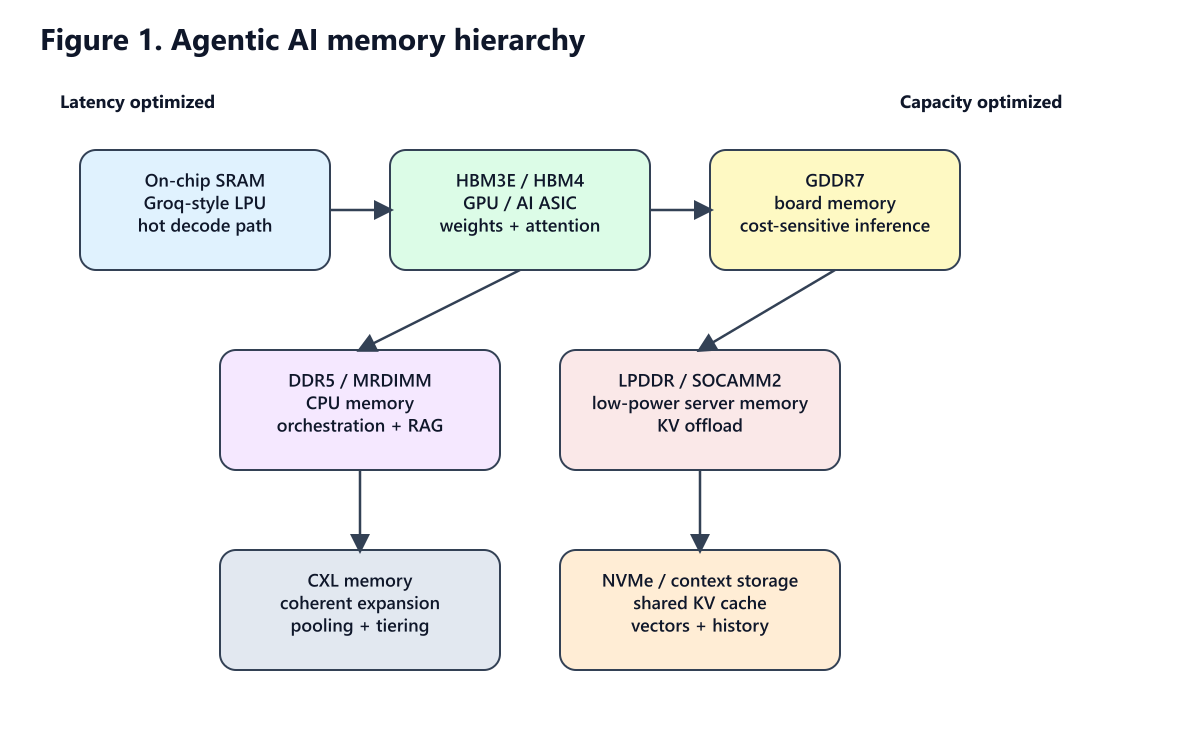
Figure 1 illustrates the memory hierarchy that modern agentic AI systems need, from latency-optimized SRAM through HBM, GDDR, DDR, CXL, and persistent context storage.
Why Agentic AI Is a Memory Problem
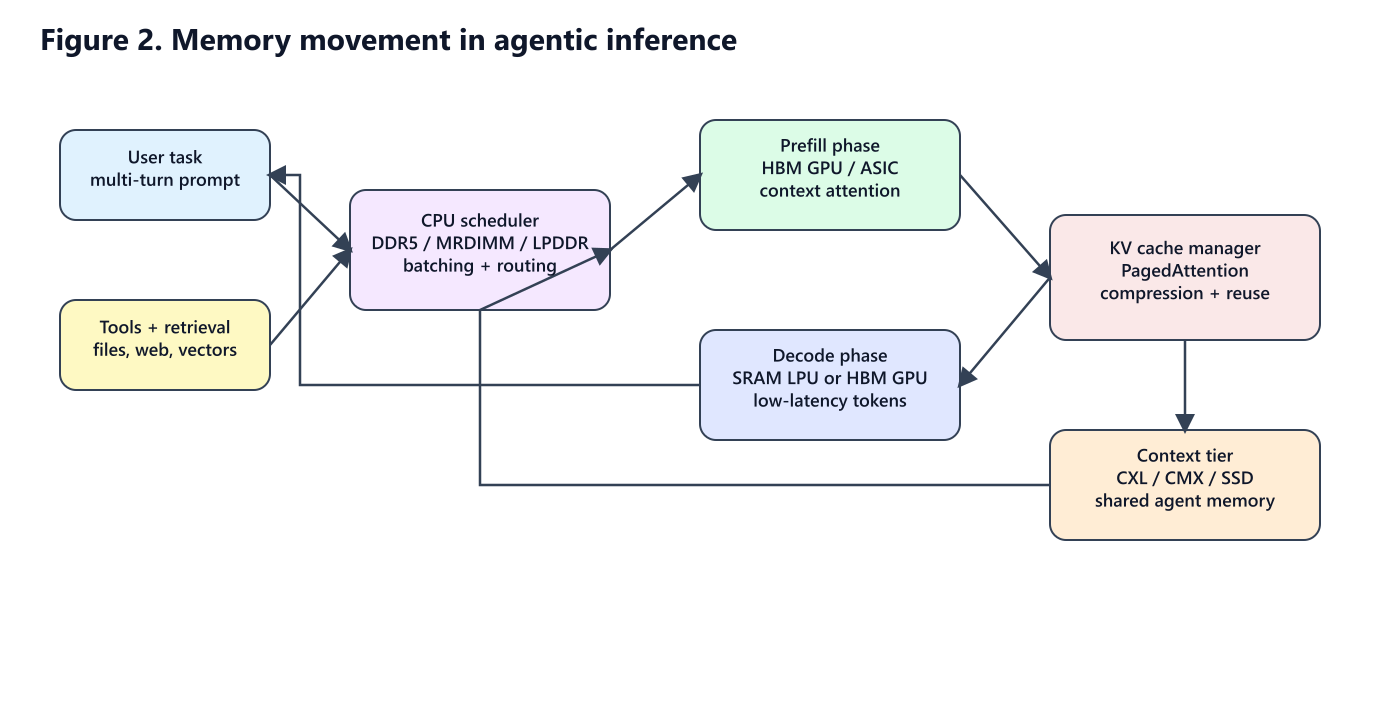
Figure 2 describes how memory moves during an agentic inference loop, where CPU scheduling, HBM-backed prefill, decode, KV cache management, and context storage all participate in the same user-facing response.
Traditional chatbot inference can often be simplified as: load model weights, process a prompt, generate tokens, return an answer. Agentic AI is different. Agents reason over longer horizons, maintain memory across turns, call tools, search external data, coordinate with other agents, and often run multiple inference passes before a user sees the final result.
That changes the memory profile in five ways.
First, token volume rises sharply. NVIDIA states that agentic systems can consume up to 15 times more tokens than traditional AI applications, and its Vera Rubin/Groq LPX messaging is explicitly aimed at trillion-parameter and million-token-context workloads. More tokens mean more attention work, more KV cache, more intermediate state, and more pressure on memory bandwidth.
Second, long context shifts the bottleneck from weights to KV cache. A 2026 UC Berkeley technical report summarizes the key systems reality: LLM generation is heavily memory-bandwidth-bound, and as context grows, the main memory traffic shifts from model weights to KV cache. This is why vLLM's PagedAttention, KV cache quantization, context offload, and AI-native storage have become infrastructure topics rather than mere software optimizations.
Third, latency matters more than peak throughput. Agents are interactive. A coding agent, customer-support agent, robot planner, or research assistant must stream useful output with predictable latency. Batch throughput alone is not enough. This favors SRAM-first deterministic architectures, better scheduling, disaggregated prefill/decode systems, and memory tiers that reduce tail latency.
Fourth, memory has become a revenue lever. Cloud AI economics are priced in tokens per second, time to first token, tokens per watt, and served context length. If a system's HBM is stranded, fragmented, or underfed by CPU/storage/network tiers, expensive accelerators sit idle. The business case for memory is therefore not just component cost; it is accelerator utilization and token factory throughput.
Fifth, agentic AI uses more than accelerator memory. Tool calls, vector retrieval, document stores, browser state, code repositories, logs, and persistent conversation memory live outside the GPU. That pulls DDR, LPDDR, CXL memory, SSD, and networked storage into the AI memory stack.
The Agentic AI Memory Hierarchy
Think of modern AI memory as a tiered system:
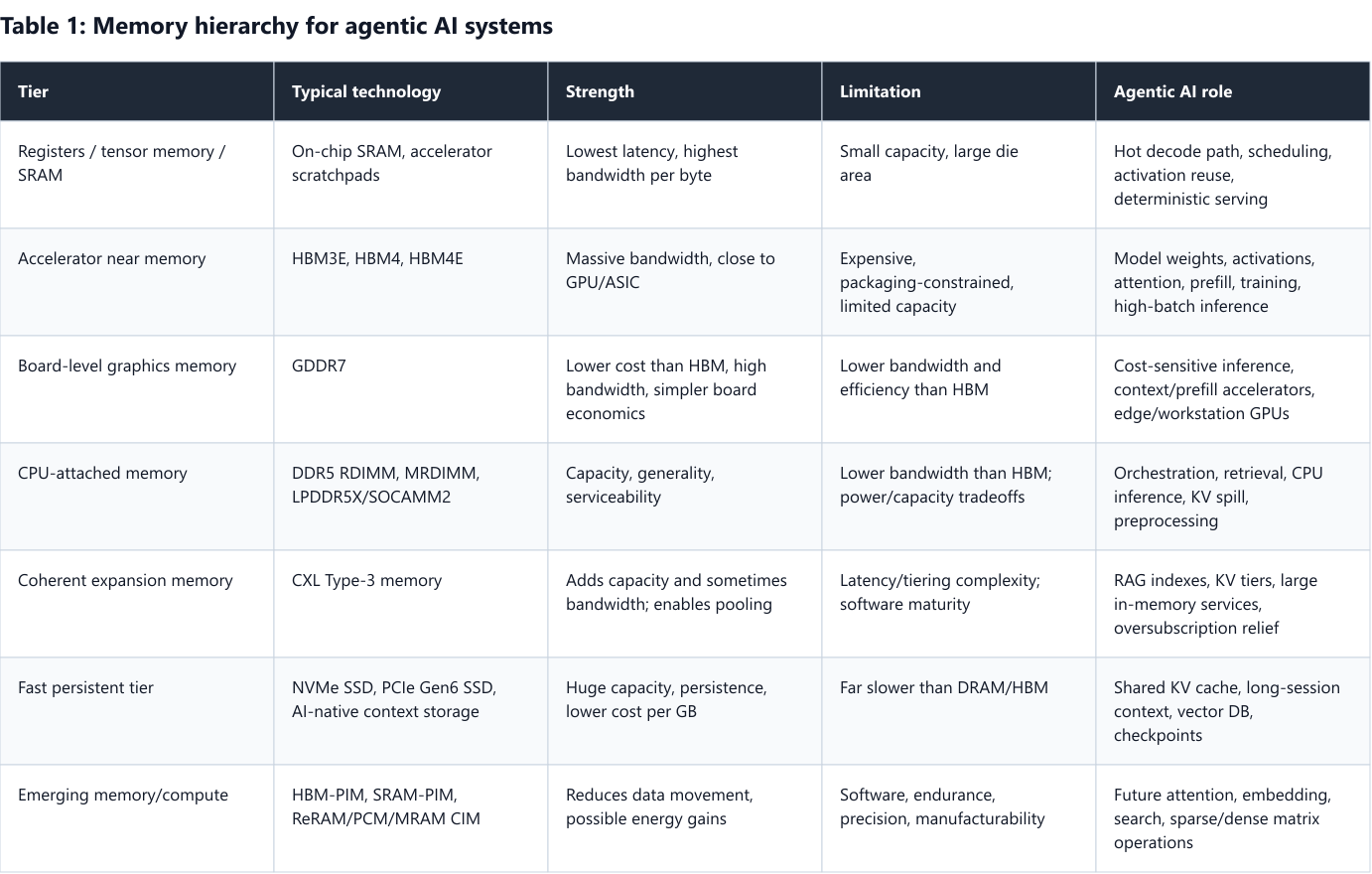
Table 1 summarizes the main memory tiers available to agentic AI systems and explains where each tier fits technically and economically.
The right architecture depends on the workload. Training and large prefill want HBM. Low-latency decode wants SRAM, efficient scheduling, and low-jitter communication. RAG and memory-heavy agents want DDR/CXL/SSD tiers. Edge agents want LPDDR and GDDR7 more than HBM.
DDR5, RDIMM, and MRDIMM: Still the Workhorse
DDR is not glamorous compared with HBM, but it remains the bulk memory of AI systems. Every AI server still needs CPU memory for operating systems, runtime engines, request scheduling, tool execution, preprocessing, retrieval, networking buffers, and memory-mapped datasets.
DDR5 RDIMM
DDR5 RDIMM is the mainstream server memory tier. Its advantages are capacity, maturity, replaceability, and broad CPU support. It is not fast enough to feed a large accelerator directly, but it is essential for keeping the rest of the system from starving the GPU. In agentic systems, DDR5 often holds:
tokenizer and routing state;
tool-call runtime data;
RAG and vector-search working sets;
CPU-side model shards for small or medium models;
data-loader buffers;
KV cache overflow or staging buffers;
multi-tenant scheduler metadata.
The challenge is that DDR5 is now competing for wafers with HBM. S&P Global reports that as Samsung, SK hynix, and Micron divert capacity toward HBM, conventional DRAM supplies are tightening and prices are rising. Reuters separately reported that memory makers' shift toward HBM has squeezed supply in nearly every other sector.
MRDIMM
MRDIMM, or Multiplexed Rank DIMM, is one of the most important near-term upgrades for CPU-attached memory bandwidth. Micron describes its DDR5 MRDIMM as delivering up to 8.8K MT/s and up to a 39% bandwidth improvement, with lower loaded latency for capacity- and bandwidth-sensitive workloads. Intel's Xeon 6 MRDIMM brief similarly positions MRDIMM as a way to break the CPU memory wall for HPC and AI workloads.
For agentic AI, MRDIMM matters because CPU-side services are no longer idle helpers. They run retrieval, ranking, compilers, sandboxed tools, logging, streaming, security, and sometimes CPU inference. A faster CPU memory tier can reduce time to first token when data preparation and retrieval sit in front of the model.
Business Implication
Enterprises should not treat DDR procurement as routine in 2026. High-capacity DDR5 RDIMMs and MRDIMMs are strategically important and exposed to the same AI-driven shortage. Buyers should secure memory configurations at the same time as server platforms, not after the GPU decision.
LPDDR5X, SOCAMM2, and LPDDR6: Low-Power Memory Moves Into Servers
LPDDR used to mean smartphones and laptops. In AI infrastructure, that boundary is breaking down.
NVIDIA's Vera CPU uses LPDDR5X and claims up to 1.2 TB/s of memory bandwidth at half the power of general-purpose CPUs. Micron's 256GB SOCAMM2 module, announced in March 2026, is a stronger signal. Micron says the module uses one-third the power and one-third the footprint of standard RDIMMs, enables 2TB LPDRAM per 8-channel CPU, and improves time to first token by more than 2.3 times for long-context real-time LLM inference when used for KV cache offload.
This matters because AI data centers are now power-limited. A rack may be constrained by available megawatts before it is constrained by floor space. If LPDDR server modules can provide enough capacity and bandwidth at much lower power, they free power budget for GPUs and networking.
LPDDR6 is the next step. JEDEC released the LPDDR6 standard in 2025, targeting higher data rates for mobile and AI memory. In practice, LPDDR6 will likely appear first in premium mobile, AI PC, and tightly integrated server designs before it becomes a general server memory replacement.
Business Implication
SOCAMM2 and LPDDR server memory are not merely "mobile memory in a server." They are part of a power-density strategy. Hyperscalers will adopt them where the workload benefits from high CPU memory bandwidth per watt, especially for agent orchestration, context management, and CPU-side inference.
HBM3E, HBM4, HBM4E, and HBM5: The AI Accelerator Memory Core
HBM is the premium memory tier for AI accelerators. It stacks DRAM dies vertically, connects them with through-silicon vias, and places the stack near the accelerator on an advanced package. The result is much higher bandwidth per watt than conventional DIMMs, but with far more complex packaging and capacity constraints.
HBM3E
HBM3E powers the current generation of high-end AI accelerators, including NVIDIA Blackwell and AMD Instinct MI325X/MI350-class products. AMD lists MI350-series GPUs with up to 288GB HBM3E and 8TB/s peak theoretical memory bandwidth. NVIDIA Blackwell B200-class systems are widely specified around 180GB HBM3E and roughly 7.7TB/s GPU memory bandwidth, while GB200 reaches about 186GB and 8TB/s.
HBM3E is mature enough for volume deployment but not abundant enough for unconstrained demand. It remains central to training, post-training, and high-throughput inference.
HBM4
HBM4 is the major 2026 transition. JEDEC's HBM4 standard doubles the interface width to 2,048 bits. Micron says its HBM4 offers more than 2.8TB/s per stack, twice the bus width, and more than 20% better power efficiency versus its HBM3E. Samsung announced HBM4 mass production and commercial shipments in February 2026, claiming up to 3.3TB/s per stack and capacities from 24GB to 36GB in 12-layer stacks, with up to 48GB planned via 16-layer stacking. NVIDIA's Rubin GPU is specified with 22TB/s of HBM4 bandwidth per GPU.
HBM4 changes system design because it improves both per-stack bandwidth and system-level efficiency. But it also deepens the supply problem: wider interfaces, advanced logic base dies, thermal control, and packaging yield all become more demanding.
HBM4E and HBM5
HBM4E samples are expected in 2026 from leading suppliers, while HBM5 is already being discussed publicly as a thermal and packaging challenge as much as a speed challenge. Samsung showed an HBM5 mockup at Computex 2026, and SK hynix has discussed integrated cooling approaches for future HBM generations.
The direction is clear: future HBM will require more than faster DRAM. It will require thermal engineering, advanced packaging, base-die customization, and closer GPU-memory co-design.
Business Implication
HBM is not just a memory component; it is a supply-chain control point. A cloud provider that secures HBM allocation can deploy AI capacity. One that cannot may have GPUs, servers, or data-center power plans delayed. This is why major buyers are signing multi-year supply agreements and why HBM pricing power is unusually strong.
Groq and SRAM-First Inference: Trading Capacity for Latency
Groq's LPU architecture is important because it attacks the memory wall from the opposite direction. Instead of relying on off-chip HBM, Groq uses large on-chip SRAM as primary working storage, compiler-controlled scheduling, and deterministic chip-to-chip communication.
Groq states that its LPU uses hundreds of MB of on-chip SRAM as primary weight storage rather than cache. Its technical explanations emphasize deterministic execution, explicit data movement, and high on-chip memory bandwidth. Groq cites on-chip SRAM bandwidth above 80TB/s, compared with about 8TB/s for GPU off-chip HBM in its comparison.
NVIDIA's 2026 Groq 3 LPX materials push this idea further. NVIDIA describes Groq 3 LPU accelerators with 500MB of SRAM per LPU, 150TB/s SRAM bandwidth, and 2.5TB/s scale-up bandwidth per LPU. An LPX rack contains 256 LPUs, for 128GB SRAM and 40PB/s SRAM bandwidth per rack, plus DDR5 memory for larger workloads.
The technical tradeoff is straightforward:
SRAM is extremely fast and predictable.
SRAM is expensive in die area and far smaller than HBM or DDR.
Large models must be partitioned across many chips.
The compiler and interconnect become central to performance.
This makes SRAM-first designs attractive for decode-dominant, low-latency inference, especially where a small batch size or interactive workload makes HBM bandwidth less efficient. It is less obviously a full replacement for HBM-heavy training or large prefill.
Business Implication
Groq-style architectures are a hedge against HBM scarcity and a specialized tool for premium inference. If agentic AI shifts the market toward low-latency, high-value tokens rather than only bulk throughput, SRAM-first inference could capture meaningful workloads. The business risk is ecosystem maturity: GPUs have a deep software stack, while SRAM-first systems require stronger compiler and model-mapping support.
GDDR7: A Cost-Efficient Inference Memory Tier
GDDR7 sits between commodity DDR and HBM. It offers high bandwidth on a board-level interface without the same 2.5D packaging burden as HBM. JEDEC published the GDDR7 standard in 2024, and Micron positions GDDR7 for gaming, AI inference, and high-performance computing workloads.
In AI systems, GDDR7 is most interesting for cost-sensitive inference accelerators and context-phase accelerators. NVIDIA's Rubin CPX announcement in 2025 described a GPU for massive-context inference with 128GB of GDDR7. Even if individual product roadmaps shift, the architectural idea is important: not every inference accelerator needs HBM. Some workloads want a cheaper, cooler, board-level memory pool with enough bandwidth for prefill or context processing.
Business Implication
GDDR7 may become a pressure-release valve for HBM-constrained inference markets. It cannot match HBM bandwidth per watt, but it can improve system cost and availability for workloads where HBM is overkill.
CXL Memory: Expansion, Pooling, and the End of Stranded DRAM
Compute Express Link is a coherent interconnect over PCIe that allows CPUs and accelerators to access attached memory devices with cache-coherent semantics. CXL Type-3 memory expanders can add capacity, and CXL fabrics can eventually enable memory pooling.
The CXL Consortium says CXL 3.1 extends memory sharing and pooling to avoid stranded memory and facilitate memory sharing between accelerators. Micron and Intel published experimental results using CXL memory modules on Intel Xeon 6 processors: eight CXL E3.S devices plus DDR5-6400 across 12 channels improved read-only bandwidth by 24%, mixed read/write bandwidth by up to 39%, and delivered a 24% geometric mean speedup across tested HPC and AI workloads.
For agentic AI, CXL is attractive for:
vector indexes and RAG data structures;
oversized CPU memory pools;
KV cache overflow;
multi-tenant memory pooling;
reducing stranded DRAM across servers;
serving medium models where HBM is too expensive.
The constraint is software. CXL memory is not magic HBM. Placement, NUMA policy, latency sensitivity, kernel support, allocator behavior, and application awareness all matter.
Business Implication
CXL is a medium-term infrastructure lever. It can reduce overprovisioning and improve utilization, but enterprises should pilot it with real workloads rather than assuming transparent gains. The most immediate value is memory capacity and bandwidth expansion for CPU-heavy AI services, not replacing HBM attached to accelerators.
NAND, SSD, and Context Memory: Storage Enters the Inference Loop
Agentic workloads create persistent and semi-persistent context. A long-running agent may reuse previous conversation state, tool results, documents, code context, and KV cache across turns. Keeping all of that in HBM is impossible; recomputing it wastes power and increases latency.
NVIDIA's BlueField-4 and CMX context memory platform are a sign of where the market is going. NVIDIA describes CMX as an AI-native context tier for long-context, multi-turn, and agentic AI inference. It extends GPU memory with a shared pod-level context tier optimized for ephemeral KV cache, using BlueField-4, DOCA, Spectrum-X Ethernet, and Dynamo to manage KV-aware placement and reuse.
This is a new role for storage. SSDs are no longer only for datasets and checkpoints. They are becoming part of the active inference memory hierarchy. That increases demand for enterprise SSDs and NAND just as DRAM is also tight.
Business Implication
AI buyers should plan storage as part of inference architecture, not as an afterthought. Context-cache hit rate, networked KV sharing, and SSD endurance can affect token economics. This will also pull NAND into the AI shortage narrative.
Processing-in-Memory and Compute-in-Memory: The Longer-Term Escape Route
The root problem in AI is data movement. Moving bytes from memory to compute often costs more energy and time than the arithmetic. Processing-in-memory tries to move some compute into or near memory.
Samsung's HBM-PIM integrates AI processing into HBM banks to reduce data movement, and Samsung has reported potential performance and energy benefits for AI/HPC workloads. Research on ReRAM, PCM, MRAM, and analog compute-in-memory goes further by using memory cells or near-memory circuits to perform multiply-accumulate operations.
The promise is large:
less data movement;
better energy efficiency;
high parallelism for matrix-vector operations;
possible acceleration for embeddings, search, attention, and sparse operations.
The limitations are also real:
analog precision and noise;
endurance and variability;
compiler and programming model maturity;
integration with transformer software stacks;
manufacturability and yield;
limited support for rapidly changing model architectures.
Near term, PIM is more likely to appear as specialized acceleration inside memory subsystems than as a wholesale replacement for GPUs. Over the longer term, hybrid SRAM-PIM/HBM-PIM/ReRAM-CIM designs may become valuable for inference, especially for edge AI or memory-bound attention.
Why the Memory Shortage Is Happening
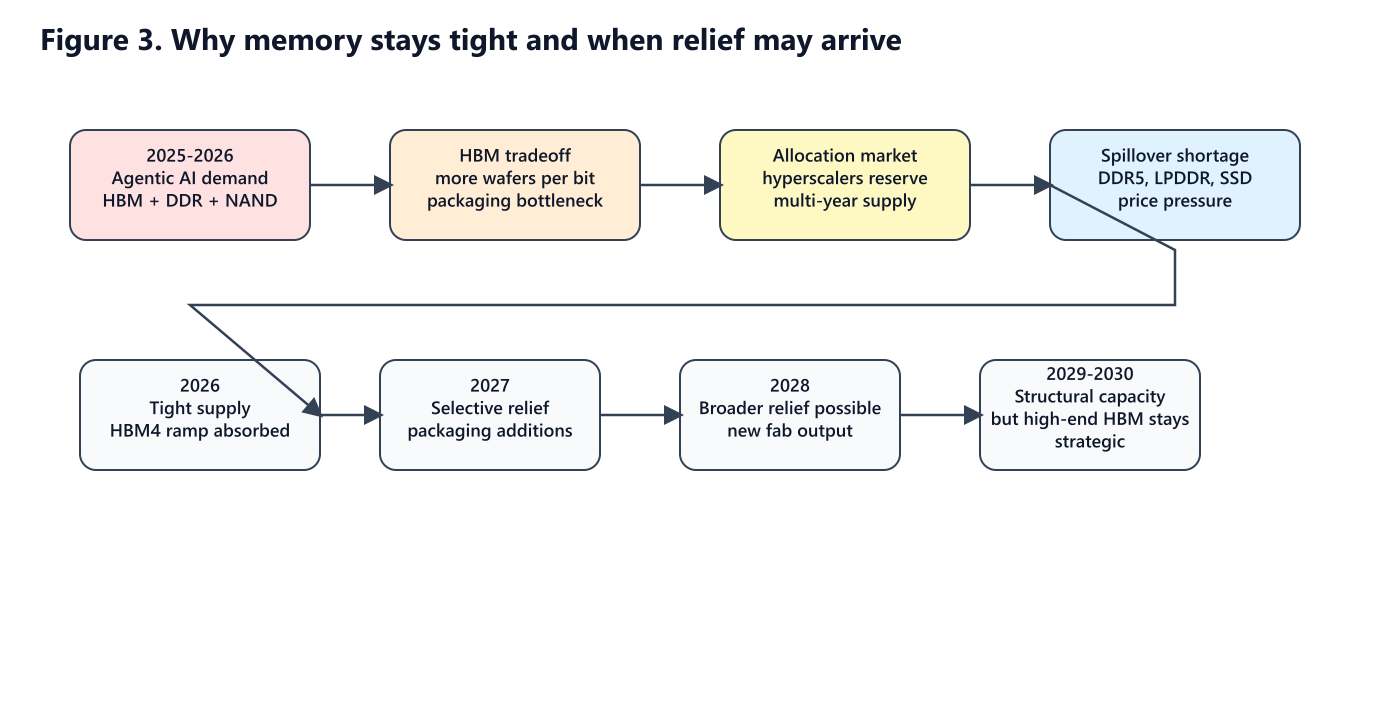
Figure 3 discusses the supply chain logic behind the shortage and the likely timing of relief, showing why 2026 remains tight even as new HBM, packaging, and fab capacity begins to arrive.
The shortage has several reinforcing causes.
1. AI Demand Expanded Across Every Memory Tier
Training consumed HBM first. Inference then expanded demand for HBM, DDR5, LPDDR, eSSD, and networking buffers. Agentic AI adds KV cache, long context, multi-agent state, and storage-backed memory. This demand is broader than the 2020-2021 PC/consumer electronics cycle.
2. HBM Consumes More Wafer and Packaging Capacity
Micron has said the dramatic increase in HBM demand challenges the supply environment because of a 3-to-1 trade ratio with DDR5, and that the trade ratio increases with future HBM generations. In plain language: shifting wafer capacity to HBM reduces the number of conventional DRAM bits the industry can ship.
3. Advanced Packaging Is a Bottleneck
HBM requires stacking, TSVs, base logic dies, interposers or advanced substrates, thermal management, and close coordination with accelerator packages. Even if DRAM wafer output rises, HBM output can remain limited by packaging, testing, yield, and customer qualification.
4. Suppliers Are Rationally Chasing Margin
HBM and high-capacity server memory carry better margins than commodity DRAM. Memory makers are financially incentivized to prioritize AI products, which tightens supply for PCs, smartphones, automotive, industrial, telecom, and legacy systems.
5. Legacy Memory Exits Backfired
Reuters reported that production shifts away from DDR4 and LPDDR4 coincided with stronger-than-expected traditional demand. When suppliers tried to exit lower-margin older products, customers in PCs, embedded systems, telecom, and industrial markets had fewer alternatives.
6. New Fabs Take Years
Micron says cleanroom lead times are lengthening and expects tightness through and beyond calendar 2026. Its first Idaho wafer output is expected in mid-2027, a second Idaho fab by the end of 2028, and New York supply in 2030 and beyond. Micron's Singapore HBM advanced packaging facility is expected to contribute meaningfully in calendar 2027. These timelines show why 2026 supply cannot be fixed quickly.
7. Buyers Are Pre-Committing Capacity
Hyperscalers, GPU vendors, and AI labs are reserving supply years in advance. Reuters reported that major cloud and AI buyers were asking suppliers for as much memory as they could deliver. This makes spot availability worse for everyone else.
When Will Memory Become More Available?
The answer depends on the memory type.
2026: Tight and Allocation-Driven
HBM3E and HBM4 remain highly allocated. DDR5, high-capacity RDIMM, LPDDR server memory, and enterprise SSD supply remain tight. Buyers should expect high prices, long lead times, and configuration substitutions.
Samsung's Q1 2026 results state that memory demand remains strong amid AI infrastructure expansion and that agentic AI is expected to accelerate demand in the second half of 2026. Micron's Q1 2026 prepared remarks say aggregate industry supply will remain substantially short of demand for the foreseeable future and tightness will persist through and beyond calendar 2026.
2027: Selective Relief, Not Normalization
The first meaningful relief should come from HBM4/HBM4E ramps, additional advanced packaging, and new/expanded cleanroom output. Micron expects its Singapore HBM packaging facility to contribute meaningfully in 2027. But demand from Rubin-class systems, AI ASICs, and hyperscalers is likely to absorb much of that supply.
For enterprise buyers, 2027 should be better than 2026, but not cheap or unconstrained. Expect better availability for contracted buyers and continued difficulty for spot purchases.
2028: Broader Relief Becomes Plausible
By 2028, more fab and packaging investments should be in production. Micron expects a new NAND fab in Singapore to begin initial wafer output in 2028 and its second Idaho fab to be operational by the end of 2028. If AI demand growth moderates, this is the earliest plausible window for broader supply normalization.
However, if agentic AI adoption accelerates faster than capacity, 2028 may only shift the shortage from severe to manageable.
2029-2030: Structural Capacity Arrives, But So May Structural Demand
Large fab projects and supplier capacity expansions become more meaningful by 2029-2030. Micron expects New York supply in 2030 and beyond. SK hynix leadership has reportedly discussed doubling wafer capacity over five years while warning that AI-driven shortages may persist toward 2030.
The base case is that memory becomes more available in 2028-2029, but the highest-end HBM remains strategically allocated. The bull-demand case is that shortages persist in some form into 2030. The bear-demand case is that an AI capex slowdown produces a faster price correction in 2027-2028, but that would likely come with broader AI infrastructure spending cuts.
Technology-by-Workload Recommendations
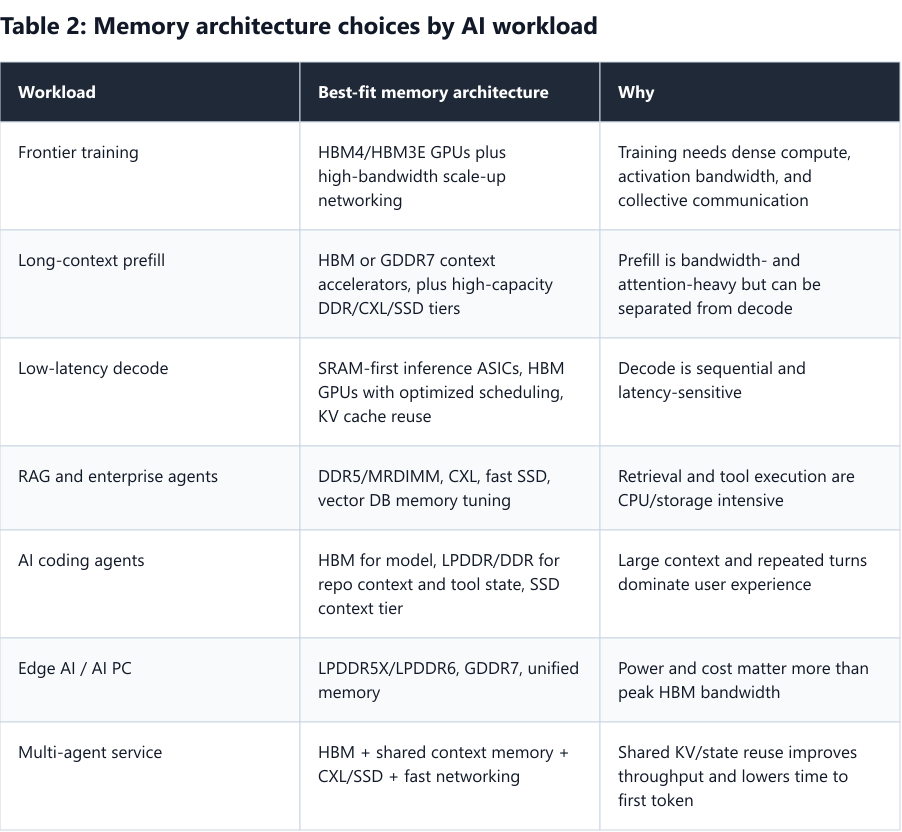
Table 2 summarizes practical memory architecture choices by workload type, connecting the technical memory tiers to buying and deployment decisions.
Business Strategy for Buyers
Buy memory as a strategic input, not an accessory. Secure HBM, RDIMM/MRDIMM, LPDDR server modules, and SSD allocation with platform orders.
Architect for memory tiers. Do not assume all context belongs in HBM. Use PagedAttention-style serving, KV cache quantization, prefix sharing, CPU/LPDDR offload, CXL, and SSD context tiers.
