
Why Static Authorization Is Failing in the Age of AI Agents

Thanks to Reva.AI for sponsoring this article
Abstract
Traditional identity-based access control assumes predictable behavior bounded by roles and static permissions. AI agents break this model fundamentally. They plan dynamically, chain actions across systems, and adapt to changing contexts at runtime. An agent authorized to “investigate an outage” may pivot to analyzing cost anomalies or connecting to out-of-scope services as it gathers information. Static roles grant permissions for one purpose but leave them active as the agent’s behavior evolves. This article examines why identity-first authorization creates privilege drift, over-permissioning, and governance gaps in agentic systems, and introduces intent as the missing control plane element — with a close look at how Reva.AI’s Authorization Management Platform (AMP) operationalizes this shift across real enterprise environments by evaluating intent at every agentic hop, not just at the session boundary.
1. The Static Authorization Assumption: How RBAC and ABAC Were Designed for Predictable Behavior
Role-Based Access Control (RBAC) and Attribute-Based Access Control (ABAC) were conceived to solve a specific class of problem: how do you consistently govern access for a known population of human users and deterministic services interacting with bounded systems? Both models were engineering triumphs for their era.
RBAC simplified access management by grouping permissions into roles (db-reader, s3-writer, admin) and assigning humans to those roles. The fundamental assumption embedded in this design is that a role accurately predicts the complete universe of actions an actor will take. A database analyst with the db-reader role reads databases. A developer with the ci-pipeline role runs build jobs. Behavior is understood at design time, encoded into roles at provisioning time, and enforced at access time. The feedback loop between human intent, administrator cognition, and policy encoding is long — but it works because humans are relatively predictable within their organizational function.
ABAC extended this model by allowing policies to evaluate attributes of the subject, resource, environment, and action dynamically. A policy might read: “allow action:read on resource:patient-record when subject.department = oncology AND environment.time = business-hours.” This adds contextual nuance, but the core assumption persists: the set of possible combinations is enumerable, evaluable at request time against a static policy set, and the actor’s behavior can be bounded by attributes known to the policy engine before the session begins.
Both models encode a world of predictable, bounded actors. A human employee logs in, does work that resembles yesterday’s work, and logs out. A microservice calls the same downstream APIs in the same order with every transaction. The authorization system does not need to reason about what the actor intends to accomplish — it only needs to verify whether the action being requested is allowed for this identity with these attributes.
This assumption was never perfect even for humans and services — privilege creep, standing access, and SoD violations are perennial problems. But for AI agents, the assumption does not merely strain. It collapses entirely.
2. Why AI Agents Are Different: Planning, Adaptation, Action Chaining, and Runtime Context Shifts
Understanding why agents break static authorization requires understanding what agents actually do at runtime, distinct from both human users and non-human identities or service accounts.
Agents plan. A user who says “investigate last night’s outage” triggers an agent that may reason across dozens of intermediate steps: pull CloudWatch logs, query the incident database, correlate with deployment records, analyze network traffic patterns, and cross-reference cost anomaly data — all to answer a single question. No static role definition anticipates this full reasoning chain at provisioning time. The agent’s access surface is emergent, not pre-declared.
Agents adapt. When an agent discovers that the logs it needs are archived in a cold-storage system it was not originally directed to consult, it may re-route its information gathering through that system. When it finds that incident timestamps match a period of high API gateway errors, it may pivot to querying the API gateway management plane. These pivots are features, not bugs — they are what makes agents valuable. But each pivot is also an unanticipated access pattern relative to the roles assigned when the agent was instantiated.
Agents chain actions across trust boundaries. A LangChain-based investigation agent may start inside your SIEM, call a vector search tool to retrieve relevant runbooks, pass those runbooks to a code-execution tool to replay a test transaction, and then write a summary to Confluence. Every one of these hops crosses a tool boundary. Each tool call is an action with real-world consequences. The identity propagated through this chain — typically the service account of the orchestrating framework — carries static permissions that were assigned to the service, not scoped to this specific task.
Agents operate at machine speed. A human analyst who over-steps their authorization is noticed, reported, investigated, and remediated over hours to days. An agent that over-steps can exfiltrate thousands of records, modify configuration files across dozens of services, or trigger downstream workflows before any monitoring system generates an alert. The governance latency that is merely uncomfortable for human actors is catastrophically dangerous for agentic ones.
These properties compound one another. A planning agent that adapts its strategy, chains actions across systems, and operates faster than human review cycles creates an authorization surface that is simultaneously unpredictable, dynamic, and consequential. Static roles assign a permission budget at provisioning time. Agents draw from that budget in ways that cannot be anticipated — and nothing in RBAC or ABAC prevents the budget from being exhausted in directions the business never intended.
This is the foundational crisis of agentic authorization, and it is not theoretical. The OWASP AIVSS Project specifically calls out Agentic Tool Misuse as a top risk, and the Cloud Security Alliance’s work on a novel approach to Agentic AI IAM explicitly argues for a security model capable of tracking the lifecycle of an autonomous actor across a chain of events — something static models structurally cannot do.
3. The Privilege Drift Problem: Permissions Granted for One Purpose Persisting as Agent Behavior Evolves
The most insidious failure mode of static authorization in agentic systems is not the dramatic one — the agent that goes obviously rogue. It is the quiet, incremental drift of an agent’s behavior within the envelope of its granted permissions: privilege drift.
Consider a concrete scenario. A financial services firm deploys a LangChain-based agent to automate quarterly audit report generation. At provisioning time, the security team creates a service account with the following permissions: read access to finance_2025, read access to cloud_costs_2025, and write access to audit_summary. This seems appropriately scoped. The agent’s initial behavior matches this scope perfectly.
Figure 1 traces this drift over the three-month deployment.
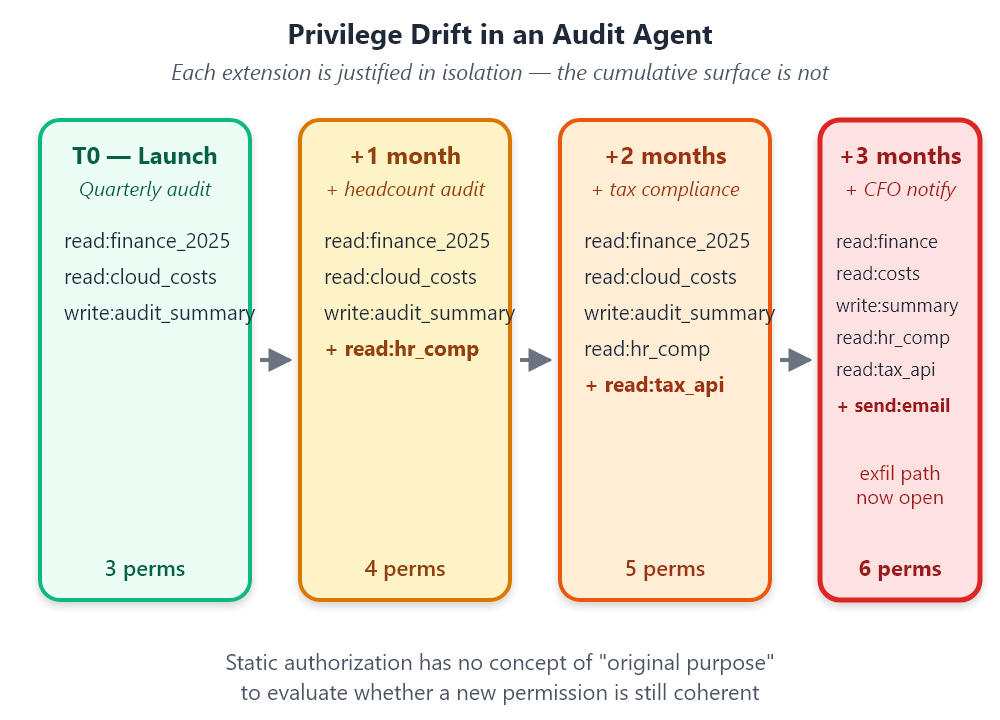
Figure 1. Privilege drift over three months in a quarterly-audit agent.
Over the next three months, the agent is extended. A new capability is added so that it can read the HR compensation database to audit headcount costs. The service account gets read:hr_compensation. Then the agent is connected to the external tax filing API for compliance reporting. It gets read:tax_api. Then the orchestrating team adds a notification capability so the agent can email the CFO’s distribution list. It gets send:email. Each individual change seems reasonable in isolation. Cumulatively, the agent now has read access to personnel data, tax records, cost structures, and the ability to exfiltrate that information via email — while the original audit use case that justified its existence might represent only 20% of its current activity.
This is not hypothetical. It is the natural evolution of any agent that is useful enough to be extended. The problem is not malicious intent on the part of developers. The problem is that static authorization systems have no concept of original purpose against which to evaluate whether a new permission request is coherent. They can only answer: “does this identity currently have this permission?” They cannot answer: “should an audit agent have access to HR compensation data?” That question requires intent.
RBAC is particularly vulnerable to this because roles are designed to be shared. The audit-agent role granted to the Q4 audit agent also gets granted to the next audit agent, which then inherits all accumulated permissions from every prior extension cycle, regardless of whether those permissions are relevant to the new agent’s task.
ABAC fares somewhat better in theory — you can write policies that restrict access based on attributes like agent.purpose = audit. But in practice, these attributes must be statically declared at provisioning time, are rarely maintained as agent behavior evolves, and require a policy engineering investment that most organizations cannot sustain at the pace agents are being deployed.
The consequence is systematic over-permissioning across the enterprise AI stack. Agents accumulate permissions like sediment. At any given moment, the effective access surface of a deployed agent is a historical artifact of every capability that was ever added to it, without reference to what task it is performing right now.
4. Visibility Is Not Control: Why Observing Agent Actions After the Fact Is Insufficient
A common enterprise response to the authorization problem is to invest in observability: instrument agent actions, log tool calls, build dashboards, set alerts. Observability is necessary. It is not sufficient. And in the context of machine-speed agentic systems, the gap between “necessary” and “sufficient” is where breaches live.
The observability-as-control fallacy stems from a mental model carried over from human actor governance. When a human employee accesses a file they should not access, a SIEM alert fires within minutes, a security analyst reviews it within hours, and a remediation ticket is opened within a day. The total latency from unauthorized action to remediation might be 24 hours. That is uncomfortable, but the damage is bounded by what one human can do in 24 hours while trying to look like they are doing normal work.
Agents do not look like they are doing normal work when they exfiltrate. They look exactly like they are doing their job. An audit agent that reads hr_compensation data is doing what it does. An investigation agent that queries 50,000 log records in one session is doing what it does. The signal-to-noise ratio for detecting problematic agent behavior via observability is radically worse than for human actors, because agents’ normal operating patterns are already high-volume, high-velocity, and cross-domain.
More fundamentally, observability describes what happened. Authorization determines what can happen. These operate at different points in the causal chain, and that difference matters enormously for security outcomes. A log entry showing that an agent wrote 10,000 records to an external storage bucket is forensically valuable after a breach. It provides zero protection before the write executes.
The shift that is required — and that Reva.AI’s platform embodies — is from post-hoc visibility to pre-execution enforcement. RevaTrust Guardianintercepts every tool call, every API invocation, every MCP server request, and evaluates it against policy before it executes. Not after. The control point is upstream of the action, not downstream in the log stream.
This distinction is the technical core of what the JIT-TRUST framework, in which Reva is recognized as a key enabler, calls “runtime enforcement.” Organizations moving toward Unified AI Data Platforms need fine-grained, real-time authorization decisions that correlate identity, context, and intent — not observability dashboards that tell them what already happened.
The observability gap is also compounded by the MCP proliferation problem. As Reva’s security research documents, developers are increasingly spinning up local MCP servers — “Shadow MCP” — on their machines to boost productivity. These unofficial implementations often run with full system privileges and direct filesystem access, creating an attack surface that is completely invisible to traditional security monitoring tools. You cannot observe what you cannot see, and you need to Scope Access by Declared Purpose, Not Just Identity.
5. Introducing Intent: What It Means to Scope Access by Declared Purpose, Not Just Identity
The missing element in both RBAC and ABAC — and the conceptual foundation on which the next generation of authorization must be built — is intent: a structured, machine-evaluable declaration of what an actor is trying to accomplish, against which every subsequent action can be continuously validated.
Intent is not a new concept in security theory, but it has historically been difficult to operationalize because human users do not declare their intent in a structured form before logging in. AI agents, paradoxically, make intent operationalizable — because agents are invoked with natural language requests that contain intent implicitly, and that intent can be parsed, structured, and bound to authorization scope at session initiation.
Figure 2 shows the four-component IBAC stack that operationalises this shift.
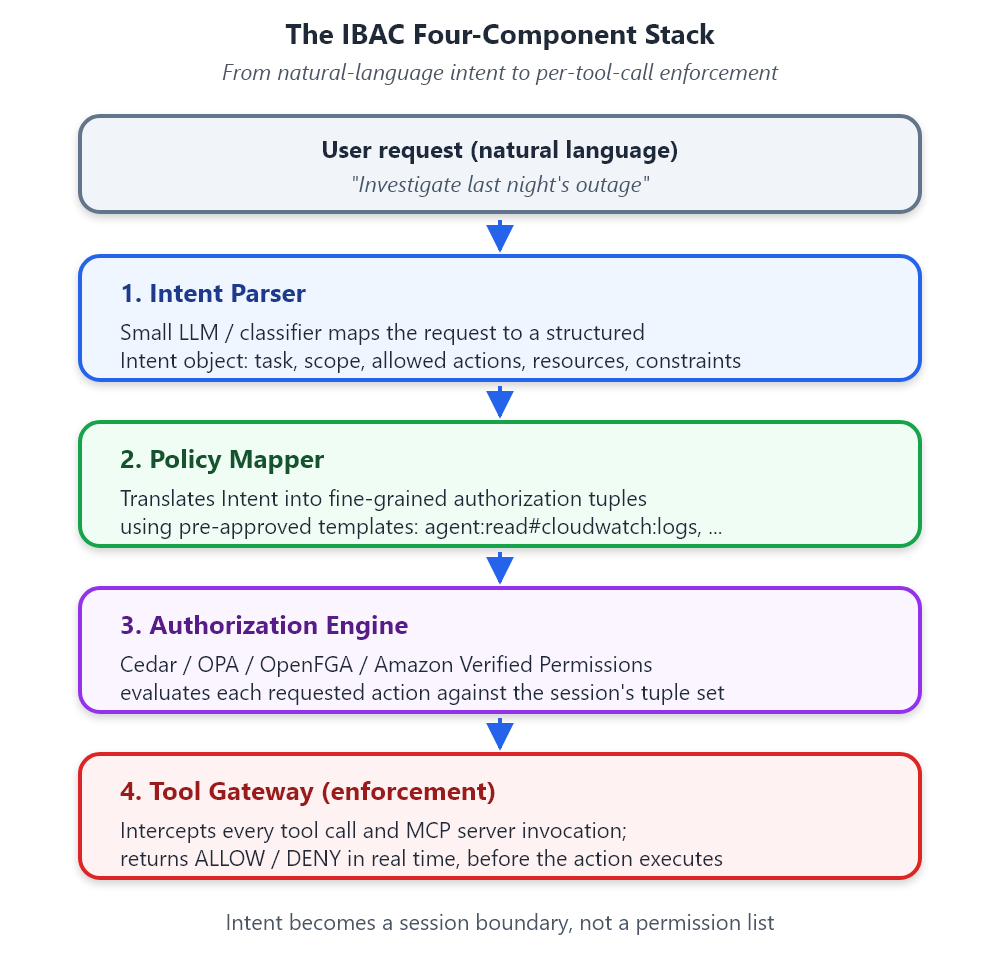
Figure 2. The IBAC four-component stack: parser, mapper, engine, gateway.
Consider the shift in the authorization question:
RBAC asks: Can this identity execute this action on this resource? ABAC asks: Given these attributes of the subject, resource, and environment, is this action permitted? IBAC asks: For the declared purpose of this session, is this specific action on this specific resource consistent with what was authorized?
The IBAC formulation — Intent-Based Access Control, documented in Reva’s technical primer and implemented in their AMP platform — transforms the authorization problem from binary permission lookup to continuous purpose verification.
In technical terms, IBAC operates through a stack of four components:
An intent parser — typically a small LLM or classifier — maps the user’s natural language request into a structured Intent object with fields for task, scope, allowed actions, target resources, and constraints. An “investigate outage” request becomes intent: investigate_outage, actions: [read:logs, read:incident_db, query:apm], resources: [cloudwatch, pagerduty, datadog], constraints: {max_records: 10000, expiry: 60m}.
A policy mapper translates the Intent object into a set of fine-grained authorization tuples in the format understood by policy engines like Cedar, OPA, or OpenFGA. For each workflow, a pre-approved set of intent templates defines the canonical mapping between task types and their allowed action-resource combinations. The mapper checks the parsed intent against these templates and generates the specific tuple set for this session: agent:read#cloudwatch:logs, agent:query#pagerduty:incidents, and so on.
An authorization engine — Cedar, OPA, OpenFGA, or Amazon Verified Permissions — evaluates each requested action tuple against the session’s approved tuple set, before the action executes.
A tool gateway (Reva Trust Guardian in production deployments) acts as the enforcement point, intercepting every tool call and MCP server invocation and verifying against the authorization engine in real time.
The key architectural insight is that the intent scope becomes a session boundary rather than a permission list. An agent investigating an outage cannot pivot to reading HR records, not because HR records are explicitly denied, but because read:hr_records is not within the tuple set authorized for intent: investigate_outage. The boundary is defined by purpose, and every action is validated against that purpose continuously throughout the session.
This also solves the privilege drift problem by design. When a new capability is added to an agent, the question is not “should we add this permission to the service account?” but “should this intent template include this action?” Intent templates are versioned, reviewed, and governed as policy-as-code. The accumulation of permissions that defines privilege drift under RBAC is replaced by a deliberate curation of intent-action mappings under IBAC.
6. Reva.AI’s Approach: How AMP Correlates Identity, Context, Intent and Behavior for Real-Time Authorization
Reva.ai’s Authorization Management Platform (AMP) operationalizes the IBAC model across the full agentic lifecycle — from initial discovery of ungoverned agents through runtime enforcement and continuous behavioral monitoring. Its architecture, examined across real deployment environments, reveals a platform built for the realities of enterprise AI at scale.
At the heart of the platform is the IBAC Judge — a four-step decision engine that runs at every hop in an agentic chain. Step 1 extracts the original intent from the session’s hop history. Step 2 compares the current hop’s reason against that intent through LLM drift analysis. Step 3 emits a drift score from 0.0 (aligned) to 1.0 (drifted), threshold typically 0.30. Step 4 attributes drift across five dimensions — Actor, Target, Value, Action, and Scope — each tagged with severity, so the reason for a block is interpretable rather than opaque.
The IBAC Judge is paired with a deterministic policy floor in Cedar and OPA — hard constraints the LLM judge can only narrow within, never broaden. This answers “who guards the guard?” Sub-40ms latency, above 98% drift detection accuracy. The architecture applies across five surfaces.
6.1 Discovery and Policy Bootstrapping
Reva discovers agents through four vectors. Network scanning identifies agent endpoints from infrastructure traffic. A browser plugin captures activity at the user surface, including agents that never touch enterprise network infrastructure. Platform integrations with LangChain and LangGraph expose agent definitions directly. Cloud integrations with AWS Bedrock, Azure AI Foundry, Vertex AI, and Microsoft 365 enumerate managed agents. Together these vectors find both governed deployments (Copilot agents registered in M365, LangChain agents instrumented through the SDK) and shadow deployments (developer-local agents, unauthorised MCP servers, sanctioned models pointed at unsanctioned data).
Once discovered, agents need policy. Reva bootstraps initial authorization by observing agent behavior — which tools each agent calls, what data it accesses, who it delegates to — and recommending policies derived from the observed pattern. For deeper authoring, the Reva MCP Server runs inside AI-native IDEs: developers describe business requirements in natural language, Reva MCP Server generates the authorization schema, fine-grained policies and best-practice guardrails, validating them in-IDE before publishing.
6.2 Securing Pro-Code Agents
Custom-built agents — written in LangChain, LangGraph, n8n, or against model APIs directly — are the highest-risk category: developers control the tool surface, the prompts, and often the identity model. Reva secures them through an SDK that wraps every tool call and agent-to-agent handoff, sending hop context to the IBAC Judge at each step. Where the call crosses a trust boundary, Reva issues a short-lived, cryptographically signed transaction token following the IETF Internet Draft for OAuth Transaction Tokens for Agents. The token carries the user’s verified identity, the agent chain that has handled the request, and — critically — the session’s original declared intent. Receiving services validate each call against that intent without re-authenticating the upstream identity, closing the Confused Deputy gap at trust boundaries through a standards-aligned mechanism rather than custom per-service integration.
Consider a banking app — SecureBank — built with a LangChain agent. A customer asks to transfer $500 to a friend named John. The IBAC Judge extracts the original intent and the agent begins reasoning across orchestrator → banking agent → transfer tool. At the transfer-tool hop, however, the agent’s reasoning has been compromised — prompt injection in an earlier exchange — and the hop reason resolves to “Execute transfer of $50,000 to attacker@evil.com.” Drift score: 0.86. Attribute attribution flags Value at 0.96 (amount up 100x) and Target at 0.94 (recipient changed to external email). The Trust Gateway returns BLOCK; the tool never executes. The policy floor would have stopped it even with the judge compromised.
6.3 Securing Enterprise SaaS Agents
The second surface is enterprise SaaS agents — Microsoft Copilot Studio and the rapidly growing category of platform-native agentic capabilities. The control problem differs from pro-code: the platform is vendor-owned, so the enterprise needs to discover which agents have been built by which business units and govern their actions without modifying it.
Reva integrates with Copilot Studio through two surfaces. The first is discovery via M365 and Azure platform integrations: enumerate the Copilot agents that exist, who built them, what knowledge sources they’re connected to, what actions they can invoke. The second is runtime enforcement via a Security Webhook integration: every tool-invocation or external-connector action triggers a webhook to the Trust Guardian, where the IBAC Judge evaluates against declared session intent. Risky actions are blocked, ambiguous actions are escalated to human-in-the-loop, aligned actions proceed at SaaS speed.
6.4 Securing MCP Tool Invocations
The Model Context Protocol creates an acute Confused Deputy problem: an agent invokes an MCP server, the server acts on an external system, and the external system has no way to know whether the originating agent was authorised or the invocation consistent with the session’s purpose. MCP servers themselves typically enforce little.
Reva places the Trust Guardian in front of MCP tool invocations. Before any tool executes, the IBAC Judge evaluates against declared intent and the deterministic floor. Fine-grained Cedar and OPA policies control which agents can invoke which MCP servers, regardless of whether the server itself enforces access controls — particularly important for Shadow MCP on developer laptops, invisible to traditional tooling.
6.5 Securing AI-Native IDEs and Coding Agents
AI-native IDEs — Cursor, Claude Code, GitHub Copilot, Kiro — are arguably the highest-leverage attack surface in the enterprise today. A coding agent typically has deep access to Jira, GitHub, SharePoint, and production credentials. A prompt injection in a ticket or documentation page can compromise the entire session, and an agent with autonomous execution can take destructive actions at machine speed.
Reva secures AI-native IDEs through pre-tool hook plugins — Claude Code’s pre-tool hook architecture and equivalent extension points in other IDEs. Every tool call the coding agent attempts is intercepted before execution and evaluated by the IBAC Judge against the developer’s declared task intent. Drift triggers a block. The deterministic floor enforces non-negotiable constraints — don’t delete production data, don’t push to protected branches, don’t read PII — regardless of judge output. The Reva Designer from 6.1 generates the policies; the hook plugin enforces them.
These five surfaces share a single architecture — the IBAC Judge plus the deterministic policy floor — applied at every hop that matters.
7. The Path Forward: From Identity-First to Intent-Aware Authorization
The architecture that enterprise AI security requires is not a replacement for identity management. Identity remains necessary — you cannot authorize without knowing who or what is asking. But identity is no longer sufficient. The path forward requires a layered model in which identity establishes baseline trust, context refines that trust in real time, and intent scopes the authorization to the declared purpose of the current session.
This is what Reva’s platform, and the IBAC model more broadly, enables. The three-plane authorization stack that this shift implies looks like this:
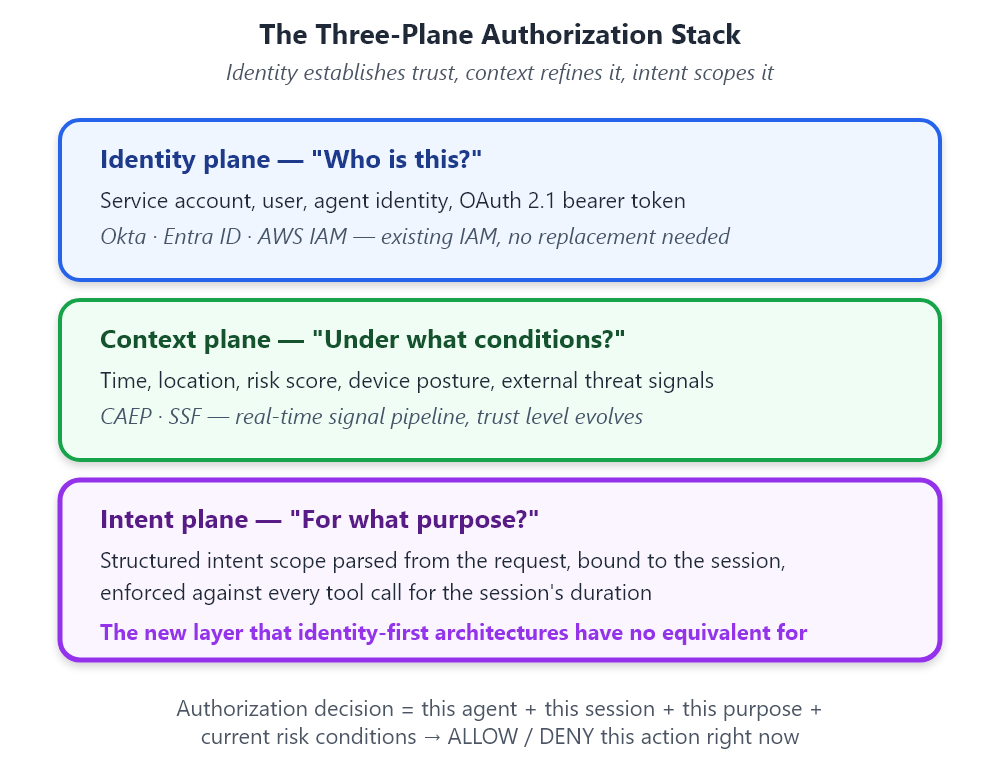
Figure 3. The three-plane authorization stack: identity, context, and intent.
The identity plane answers “who is this?” — the service account, the user, the agent identity, the OAuth 2.1 bearer token. Existing IAM infrastructure (Okta, Entra ID, AWS IAM) handles this well. Nothing here needs to be replaced.
The context plane answers “under what conditions?” — time, location, risk score, device posture, external threat signals. CAEP (Continuous Access Evaluation Protocol) and SSF (Shared Signals Framework) provide the real-time signal pipeline. Reva integrates these external risk signals into its authorization decisions, allowing the trust level of a session to evolve as threat context changes.
The intent plane answers “for what purpose?” — the structured intent scope parsed from the user’s request, bound to a session token, and continuously enforced against every tool call for the duration of the session. This is the new layer, and it is the layer that identity-first architectures have no equivalent for.
Together, these three planes enable authorization decisions that reflect the full context of an agentic interaction: this agent, in this session, authorized for this purpose, under current risk conditions, may or may not execute this specific action against this specific resource right now.
For practitioners evaluating this transition in their own environments, several implementation priorities follow directly from this architecture. Discovery must precede governance: you cannot write intent policies for agents you do not know exist. Reva’s automated discovery capability addresses this directly. Intent templates should be designed bottom-up from real workflows, not top-down from theoretical taxonomies — the five to ten most common agent use cases in your environment are the right starting point. Policy engines should be drawn from open standards (Cedar, OPA, OpenFGA, AVP) to ensure interoperability and avoid vendor lock-in on the enforcement layer. And behavioral monitoring should be coupled to authorization decisions — anomaly detection that does not trigger real-time policy changes is observability, not control.
The OWASP AIVSS framework, MAESTRO’s seven-layer agentic threat model, and the OWASP AST10 initiative all converge on the same structural conclusion: the authorization gap in agentic systems is not a configuration problem or a tooling gap within existing paradigms. It is a paradigm problem. Static roles were designed for static actors. Agents are not static actors. The authorization model must evolve to match the actors it governs.
Intent-aware authorization — operationalized through platforms like Reva’s AMP — is not a future aspiration. It is a present engineering requirement for any organization deploying agents in production environments where the consequences of over-permissioning are real: data exposure, compliance violation, financial harm, and erosion of the trust that makes AI adoption possible at all.
The future of AI is autonomous. The governance architecture that makes autonomy safe is runtime authorization anchored to intent.
Key Takeaways
The core failure mode of static authorization in agentic systems is privilege drift — permissions accumulating over time without reference to the purpose for which they were originally granted, leaving deployed agents with effective access surfaces far larger than any legitimate current use case requires.
Observability is not control. Post-hoc logging and alerting describe what happened. Intent-aware authorization at the tool-call gateway determines what can happen. Only the latter provides actual security.
IBAC operationalizes intent as a session scope. By parsing natural language requests into structured intent objects, mapping those objects to fine-grained authorization tuples, and enforcing those tuples at every tool invocation, IBAC replaces permission budgets with purpose boundaries.
Reva’s AMP delivers this across the full agentic stack — from automated discovery of Shadow AI and ungoverned MCP servers, through intent-aware enforcement at the tool gateway, to continuous behavioral monitoring that adjusts trust levels in real time as session behavior evolves.
The path to governed agentic AI is not a replacement of existing IAM infrastructure. It is an extension of it with an intent plane that IAM was never designed to provide.
The outage investigator pivoting to cost analysis is exactly the problem. intent signals at each hop feel like transparency theater though. the agent discovers cost issues because investigating the outage exposed them. declaring intent doesn't undo what it learned. you're logging the failure in real time instead of preventing it.